







Three years after obtaining authority to use a government-funded technology to make feed pellets, the Apayao Livestock-Agriculture Cooperative (ALAC) is confident it would be able to multiply its production of animal feeds not just for its members but also for the public.
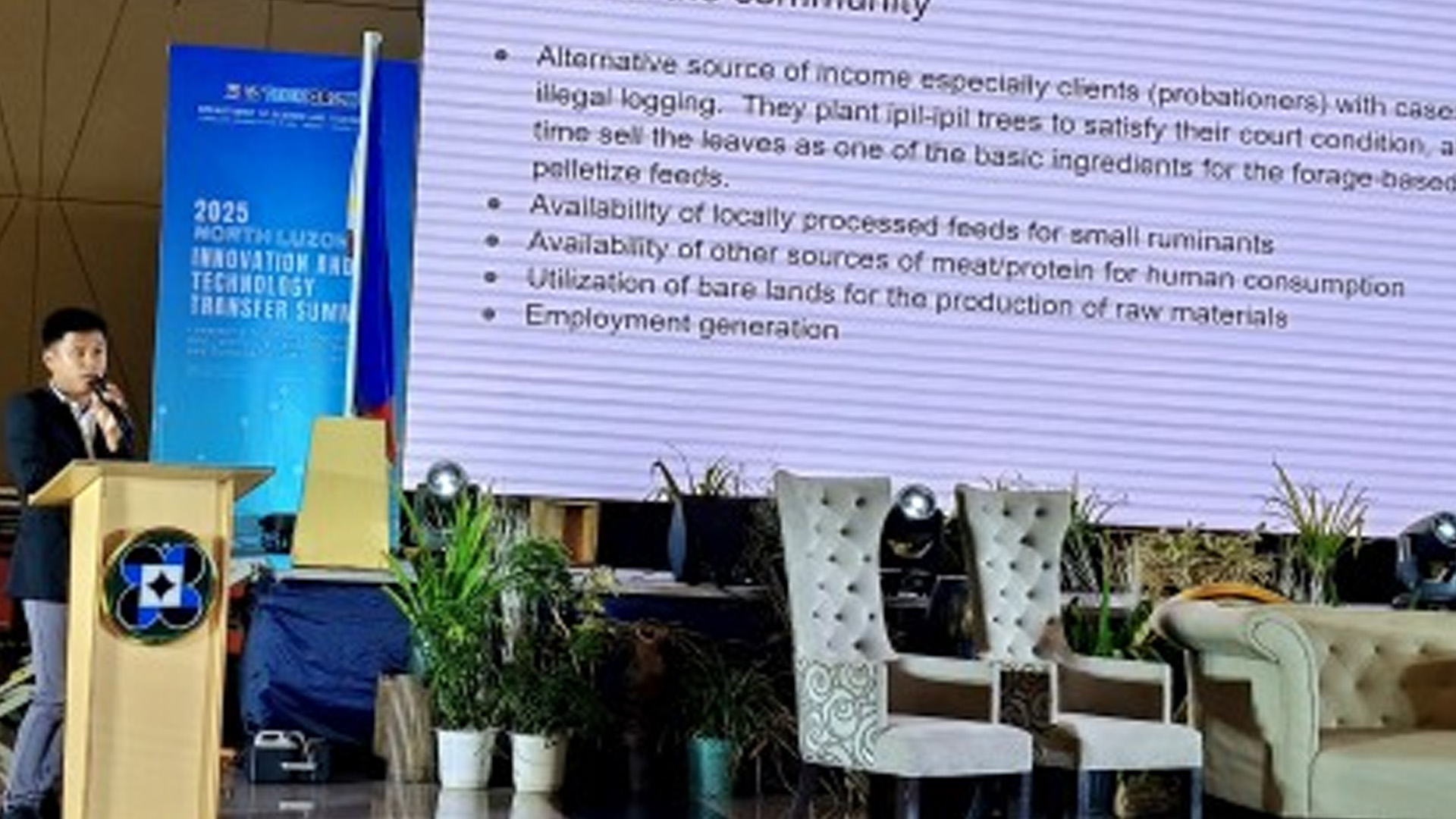
Edison Orus, who represented the ALAC during the “TechTalk” session of the 2025 North Luzon Innovation and Technology Transfer Summit here Thursday, said they look forward to increasing their production to about 1,000 kg. per month from the current 711 kg. per year of forage-based feed pellets.
He said they expect extra production they could sell to the public, which would return to the cooperative as income.
“As ways forward, we gear to produce 1,000 kg. of pellets per month, acquire a mechanical dryer, increase the production area of the raw materials, and have more market linkage with farm suppliers,” Orus said in sharing ALAC’s experience after it adopted technologies developed by researchers, developers, innovators, and scientists.
He said this would assure the group’s more than 100 members of food for their sheep and goats most of the year.
“Our feeds have a shelf-life of at least six months, ensuring food for our animals during rainy days,” he added.
Orus noted that with the help of the Department of Science and Technology (DOST) -Apayao, they were able to link up with the Central Luzon State University (CLSU) for the adoption of their technology in June 2023.
This came after the provincial government distributed sheep and goats to residents as an additional livelihood.
For almost three years after obtaining the technology, ALAC produced more than 2,000 kg. of laboratory-analyzed nutritionally balanced feed pellets using locally sourced crude protein composed of ipil leaves, rice bran, and other raw materials, which are sold to the members.
“Apayao is generally wet season. Almost year-round we have rains and those seasons are also times when grazing of animals is not feasible, thus the need for feed pellets,” Orus said.
“With the adoption of the technology, we have sure meat production for the people of Apayao, income for the ALAC members, community service compliance for the probationers, aside from income for them.”
He added that with the provincial government of Apayao continuing to help the group, they hope to increase the land area being planted with ipil-ipil trees, a source of raw materials for the feed pellets.
Debbie Mananquil, Apayao provincial science and technology officer, said their agency assisted the ALAC in adopting the technology – from the linkage with CLSU to the training.
“We still have the technology enhancement program fund that they can access, aside from the assistance they can get from the other agencies to attain their goal of 1,000 kg. a month feed pellet production,” she said.
DOST Undersecretary Sancho Mabborang earlier called for the use, commercialization, and adoption of government-funded technologies that would benefit the people. (PNA)